Essay
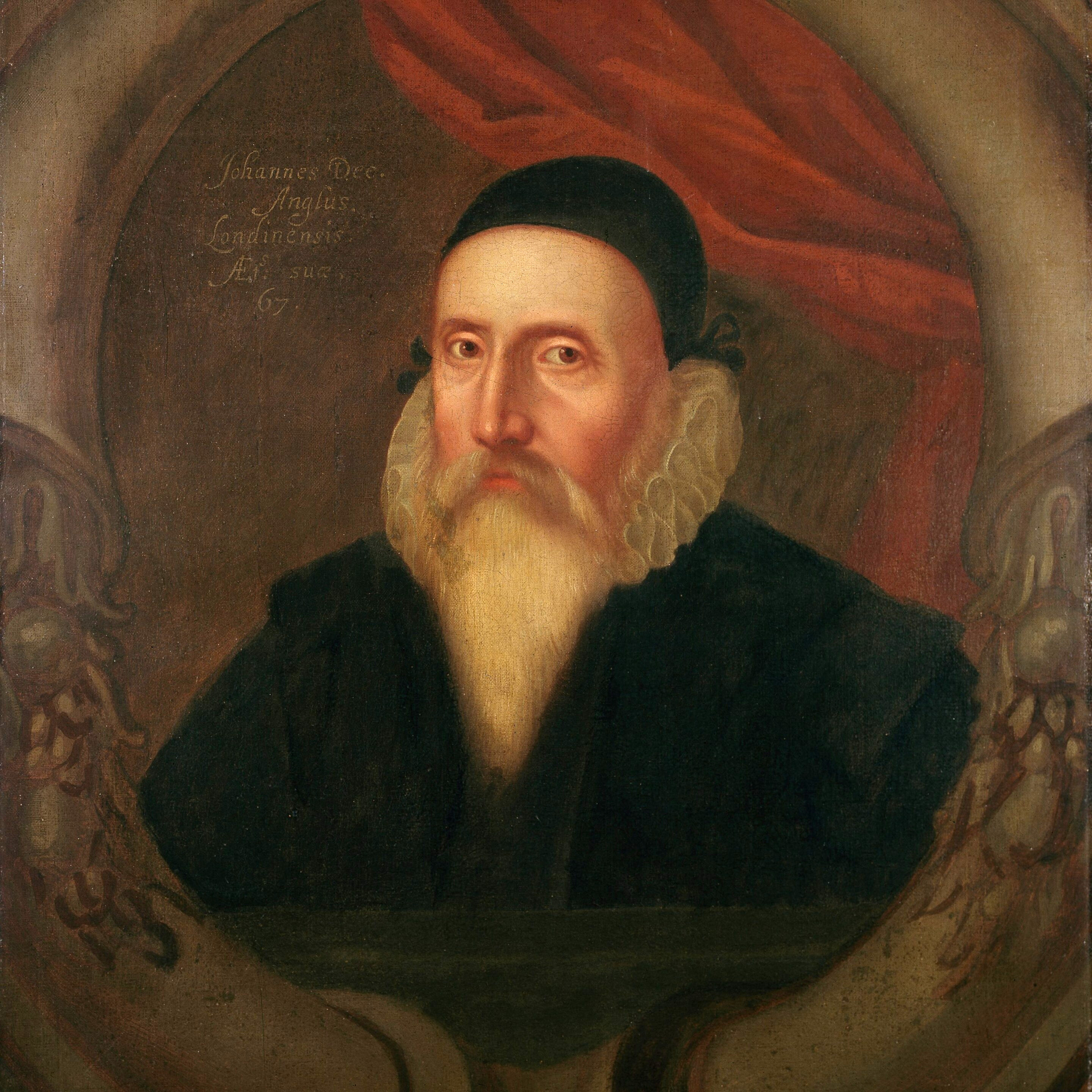
John Dee (1527–1608) stands as an enigmatic figure of the Elizabethan age, a Renaissance polymath whose life straddled the boundaries between nascent scientific inquiry and ancient occult traditions. A devout Christian, mathematician, astronomer, astrologer, alchemist, and imperial visionary, Dee wove Euclidean precision, navigational innovation, and angelic revelation into a rich framework that shaped the British Empire's intellectual foundations and Western esotericism's currents. His era saw science, magic, religion, and politics meld in dynamic tension, a worldview where the telescope's lens and the scrying stone's gleam coexisted in the mind of a single, brilliant practitioner.
Dee's legacy defies modern labels, embodying the Renaissance quest for universal knowledge. His contributions to navigation and astronomy empowered England's maritime ascent, while his alchemical treatises, Kabbalistic explorations, and angelic dialogues probed the divine. This complexity invites us to reconsider the Elizabethan mind, not as a mere precursor to modern rationality alone, but as a holistic weave where empirical rigor danced with mystical insight. His personal library, once England's greatest at over 4,000 volumes, and his spiritual diaries, preserved in institutions like the British Library, offer tangible links to this vanished world.
To explore Dee is to navigate a crossroads of history, where the seeds of modernity mingled with medieval echoes. His favor under Elizabeth I and fall under James I frame a dramatic arc, reflecting the Renaissance magus's precarious dance with power. This study delves into his roles as mathematician, philosopher, and visionary, unpacking his philosophical outlook, alchemical pursuits, Kabbalistic innovations, and cultural afterlife, where we see a figure whose refusal of boundaries challenges our narratives of progress and invites deeper reflection on knowledge's tangled roots.
John Dee's ascent as a central figure in Elizabethan England began with his birth in 1527 to a Welsh family with minor court ties. Educated at St. John's College, Cambridge, he excelled in mathematics and classics, later traveling to Louvain and Paris to study with luminaries like Gemma Frisius and Gerardus Mercator. Returning to England, he became Queen Elizabeth I's trusted advisor, earning her sobriquet "my philosopher." His counsel spanned astrological timing, such as casting her natal chart and selecting January 15, 1559, for her coronation, to navigational strategies that bolstered England's imperial ambitions.
Dee's Mortlake home housed a library of over 4,000 volumes, surpassing Oxford and Cambridge's collections combined. Cataloged in his 1583 Catalogus librorum bibliothecae Mortlacensis (Trinity College MS O.4.20), it included works by Ptolemy, Euclid, Roger Bacon, and Arabic mathematicians, alongside alchemical grimoires and Hermetic texts. Scholars like Thomas Hariot and John Davies visited this unofficial academy, borrowing tomes on astronomy and navigation. Ransacked during Dee's 1583–1589 European sojourn and later dispersals, its remnants bearing his distinctive marginalia survive in the British Library and Bodleian.
Politically, Dee entwined his intellect with England's goals. In 1570, Robert Dudley and Christopher Hatton commissioned his Brytannicæ Republicæ Synopsis, a diagnostic flowchart of England's political, economic, and social woes, advocating expansionist remedies. His 1577 General & Rare Memorials pertayning to the Perfect Arte of Navigation introduced "British Empire," a term he justified with historical precedent and maritime strategy. Dee argued, "This realm… may be enlarged by Sea Voyage," proposing naval supremacy via Euclidean geometry applied to navigation. He crafted instruments like the paradox compass, trained navigators like Martin Frobisher, and mapped potential Northeast and Northwest Passages, aiding voyages from the 1550s Muscovy Company expeditions to Humphrey Gilbert's 1583 Newfoundland claim.
Dee's imperial imagination extended to North America. He cited the legend of Madoc, a 12th-century Welsh prince who purportedly sailed west, in works like his 1578 Title Royal manuscript, asserting England's pre-Columbian claim against Spain. Presented to Elizabeth, this legal-historical argument influenced colonial rhetoric, foreshadowing later charters. His practical contributions of navigation charts, training, and instruments made him a cornerstone of England's exploratory fleet.
Elizabeth's patronage shielded Dee's esoteric pursuits. Her horseback visits to Mortlake, documented in his diaries (Ashmole MS 487), underscored her trust. Yet, James I's 1603 ascension and his remark that he had "no time for superstition or magic" marked Dee's decline. Denied court favor, he returned to Mortlake in 1589, dying in poverty in 1608, his library looted, a poignant end to a magus always reliant on royal whim and struggling for legitimacy.
Dee's natural philosophy hinged on mathematics as the gateway to God's creation, a conviction crystallized in his Mathematicall Praeface to Henry Billingsley's 1570 English translation of Euclid's Elements. This text, Dee's most influential mathematical work, offered a "Groundplat" of sciences, asserting, "Number… is the Key to all Mysteries." He extended geometry and arithmetic to navigation, astronomy, architecture, and "thinges Supernaturall," framing mathematics as a lens for both earthly and divine inquiry.
Practically, Dee revolutionized navigation amid England's maritime rivalry with Spain and Portugal. He applied Euclidean theorems to great-circle sailing, devised instruments like the quadrant and staff, and trained navigators. John Davis credited Dee's tutelage for his Arctic voyages. His 1558 Propaedeumata Aphoristica outlined astronomical theories aiding navigation, while his work with Mercator's maps informed England's exploratory edge. These efforts underpinned voyages like Frobisher's 1576 search for the Northwest Passage, cementing Dee's role in imperial expansion.
Dee's philosophy drew from Neoplatonic and Pythagorean roots, echoing Plato's Timaeus and Pythagoras's "all is number." He saw mathematical patterns as the cosmos's deep framework, uniting physical and spiritual realms. Hermeticism, via the Corpus Hermeticum, reinforced his view that humans could wield divine power through mathematics, a notion he linked to navigation's transformative potential.
This mathematical Platonism bridged Dee's pursuits. His preface argued that geometry revealed "the Image of God's wisdom," a thread connecting his navigational tools to later alchemical and angelic quests. His emphasis on practical application — building instruments, teaching apprentices — distinguished him from pure theorists and aligned him with the Renaissance shift toward empirical utility.
Dee's philosophical framework fused Christian piety with Hermeticism, Neoplatonism, and Pythagorean mysticism. His intense faith, rooted in Protestantism, framed his angel conversations — conducted after fasting and prayer — as divinely sanctioned. Writing in Sloane MS 3188, he noted, "All my Actions are with humble thanks to Almighty God," reflecting an apocalyptic urgency tied to Reformation eschatology.
Hermeticism, revived through Marsilio Ficino's translations, cast humans as co-creators with God. Dee embraced this in his Propaedeumata, stating, "Man… may ascend to the Divine." This perspective legitimized his pursuit of cosmic secrets through mathematics and ritual, aligning with contemporaries like Pico della Mirandola. Neoplatonism's emanative cosmos of divine unity cascading through mathematical order echoed Pythagorean axioms. This blend Dee articulated in his preface: "Number hath a treble State: in the Elemental world, in the Celestial, and in the Intellectual."
This approach bridged Dee's domains. His navigational mathematics reflected earthly order, while angelic dialogues sought celestial truths, all underpinned by a Christian apocalypticism casting England as a providential power. His imperial outlook, detailed in Memorials, merged practical policy with divine destiny, a "British Empire" ordained to reshape the world. Dee's philosophy rejected science-spirit divides, a stance radical for its time yet typical of Renaissance humanism. His library housed texts like Plotinus's Enneads and Agrippa's De Occulta Philosophia, fueling this integrative perspective.
Alchemy was a cornerstone of Dee's intellectual life, blending proto-chemistry with spiritual transformation. His 1564 Monas Hieroglyphica, dedicated to Emperor Maximilian II, interpreted a self-designed glyph — Mercury's crescent atop the Sun's circle, framed by planetary symbols — as a "mystical unity of all creation." Its 24 theorems, merging mathematics and Kabbalah, argued that alchemical transmutation mirrored cosmic harmony. Dee wrote, "This Monas… containeth the whole Philosophy," a claim that intrigued royal cryptographers.
The Monas sought patronage but baffled practical-minded sponsors favoring gold over philosophy. Its dense symbolism, integrating astrology, geometry, and alchemy, reflected Dee's theoretical bent. This contrasted with rivals like Cornelius Agrippa's more accessible works. Yet, Dee explored practical alchemy, as marginalia in his copy of Paracelsus's De Alchemia suggest laboratory trials, though specifics are lost.
His angelic conversations later sought alchemical secrets, with entities promising "the powder of projection" (Sloane MS 3189). Dee's 1580s travels with Edward Kelley to Rudolf II's Prague court tapped a vibrant alchemical network (Prague was home to figures like Michael Maier). Nonetheless, he failed to secure lasting support.
Dee's Kabbalistic studies, drawn from Christian reinterpretations by Pico and Reuchlin, shaped his symbolic and angelic work. The Monas Hieroglyphica applied Kabbalistic hermeneutics via letter permutations and numerical correspondences to his glyph, extending beyond Jewish texts to a universal system. He saw symbols as "living powers," a belief rooted in Kabbalah's linguistic mysticism.
His Enochian system, emerging from angelic sessions with Kelley, echoed this. Using wax tablets and a showstone, Dee recorded an "angel language" akin to Hebrew's sacred potency. Its alphabet and grammar, dictated in reverse, aimed to access primordial truth. Dee's diaries note, "The Angels say it is the tongue of Eden" (Sloane MS 3191).
Influenced by Trithemius's Steganographia, Dee's Kabbalistic approach fused Christian piety with esoteric practice. The angels' directives mirrored Kabbalah's practical mysticism, connecting him to networks like the Prague circle. His work remains a touchstone for esoteric linguists.
Frances Yates's claim in The Rosicrucian Enlightenment that John Dee was the "Founder of the Rosicrucian Order" casts him as a pivotal figure in an esoteric movement often seen as a Protestant counterweight to Jesuit intellectual dominance. While no direct evidence ties Dee to the authorship of the Rosicrucian manifestos — Fama Fraternitatis (1614), Confessio Fraternitatis (1615), and Chemical Wedding of Christian Rosenkreutz (1616) — his activities in Central Europe during the 1580s align strikingly with the intellectual currents that birthed this secretive brotherhood. Yates argued that Dee's fusion of Hermetic philosophy, mathematical mysticism, and Protestant zeal provided a template for the Rosicrucian goal of religious, scientific, and social reform, positioning him as an inspirational precursor if not a literal founder.
Dee's travels from 1583 to 1589, particularly his sojourn in Bohemia under Emperor Rudolf II, placed him at the epicenter of a cultural ferment later linked to Rosicrucianism. Rudolf's Prague court drew alchemists, astrologers, and philosophers — figures like Michael Maier, Oswald Croll, and Heinrich Khunrath — whose interests paralleled Dee's own. Arriving with Edward Kelley in 1584, Dee sought patronage by presenting his angelic revelations and alchemical expertise, as recorded in his diary (Sloane MS 3188): "I showed the Emperor… the Book of Mysteries." Though Rudolf remained skeptical, Dee's presence in this milieu, where Hermetic texts circulated alongside Protestant critiques of Catholic orthodoxy, may have seeded ideas that surfaced decades later in the manifestos. His Monas Hieroglyphica, with its cryptic blend of alchemy and Kabbalah, prefigures the manifestos' call for a "universal science" grounded in esoteric wisdom.
The Rosicrucian manifestos, anonymously published in Kassel, announced a hidden order founded by Christian Rosenkreutz, promising a "general reformation" of knowledge and faith. Their mix of Protestant piety, alchemical symbolism, and mathematical reverence echoes Dee's intellectual outlook. The Fama extols "the true Philosophy… by which all things are discovered," a sentiment akin to Dee's Mathematicall Praeface assertion that "Number… is the Key to all Mysteries." His imperial ambitions for a Protestant England, detailed in General & Rare Memorials, mirror the manifestos' geopolitical undertones — both envision a reformed Christendom led by enlightened minds. Dee's angelic dialogues, shared with European contacts, may have influenced the manifestos' apocalyptic tone, with parallels between angelic "Calls" and the Confessio's promise of divine revelation.
Yates's thesis roots Dee in the religious tensions of late Renaissance Europe. The Counter-Reformation saw the Jesuit order wield sophisticated educational networks to bolster Catholicism, prompting Protestant intellectuals to seek counter-structures. Dee, a staunch Protestant with Hermetic leanings, bridged these worlds during his European exile. In Poland, he met with King Báthory in 1585, discussing his angelic insights, while in Prague, he mingled with Protestant exiles like Francesco Pucci, whose millenarianism prefigured Rosicrucian ideals. Though Dee returned to England in 1589, his ideas may have lingered in these circles, fertilizing the intellectual soil from which Rosicrucianism sprang.
Debate persists over Dee's precise role. Critics like Charles Nicholl argue Yates overstates his influence, pointing to Johann Valentin Andreae as the manifestos' likely author, with Rosicrucianism emerging post-Dee. Yet, Dee's library, rich with texts like Pico's Conclusiones and Trithemius's Steganographia, and his contacts with figures like Philip Sidney's circle, suggest a broader dissemination of his thought. His 1586 letter to Sir Francis Walsingham, hinting at "secret societies" in Europe (Harley MS 187), fuels speculation of indirect links. Whether founder or forerunner, Dee's blend of Christian devotion, Hermetic philosophy, and practical reform indelibly shaped the esoteric landscape that birthed Rosicrucianism.
From 1582, John Dee's angelic dialogues with scryer Edward Kelley produced thousands of pages of recorded interactions (Sloane MSS 3188–3191), blending ceremonial magic, Christian devotion, and an emergent scientific curiosity into one of the most remarkable pursuits of the Elizabethan era. By the early 1580s, with lost patronage after the 1570s and exclusion from court favor following decades of service, Dee grew disillusioned with conventional scholarship. Seeking higher truths, he deepened his spiritual inquiry, documenting these efforts in manuscripts that would later become foundational texts for Western esotericism. These "actions," as he termed them, were not a rejection of his mathematical and alchemical work but an extension of his holistic quest for divine knowledge, merging the empirical with the spiritual.
Dee's methodology drew on medieval grimoire traditions, employing scryers, often pre-pubescent children, to serve as intermediaries with unseen realms. Early attempts with figures like Barnabas Saul faltered, yielding vague or inconsistent visions, but Kelley's arrival in 1582, initially under the alias Edward Talbot, marked a turning point. Kelley's vivid reports through a crystal showstone — an obsidian sphere, possibly of Aztec origin, now housed in the British Museum — captivated Dee with their detail and immediacy. Their toolkit expanded to include wax tablets inscribed with sigils, the Sigillum Dei Aemeth (a seal inspired by medieval angelology), and a conjuring table adorned with Enochian characters. Dee's diaries note meticulous preparations: "After fasting and prayer… we set the shewstone upon the Table" (Sloane MS 3188), reflecting a ritual rigor akin to Kabbalistic practice and underscoring his disciplined approach.
Dee approached these sessions with profound Christian faith, viewing them as divinely sanctioned rather than forbidden magic. He wrote, "I seek only the will of God and His holy Angels" (Sloane MS 3189), distinguishing his work from necromancy — a defense he reiterated in a 1592 letter to Archbishop Whitgift amid growing scrutiny. The angels — named Madimi, Gabriel, Uriel, and others — delivered a kaleidoscope of revelations: alchemical formulas promising the philosopher's stone, eschatological prophecies warning of imminent divine judgment, and personal directives shaping Dee's life. They instructed him to relocate to Central Europe in 1583, upbraid Emperor Rudolf II in 1584 for "pride and negligence," and, most infamously, engage in a 1587 "cross-matching" of wives with Kelley — an episode Dee reluctantly obeyed, noting, "The Angels command it, yet my heart trembles" (Sloane MS 3188). These directives reveal the angels' dual role as spiritual guides and practical influencers, pushing Dee beyond scholarly confines into a lived experiment of faith.
The Enochian language emerged during sessions of 1583–1584, dictated by angels through Kelley over months of intense scrying. Comprising an alphabet of 21 characters, a rudimentary grammar, and a vocabulary exceeding 1,000 words, it was delivered in reverse order — e.g., "Gors Vonsf Ol" for "Ol Sonf Vorsg" ("I reign over you") — to prevent unintended invocation of its potent forces. Dee believed it a prelapsarian tongue, writing, "This is the language of the Angels before the Fall" (Sloane MS 3191). The 19 "Enochian Calls," complex incantations with phrases like "Zacar od Zamran" ("Move and show yourselves"), aimed to summon celestial powers, their syntax blending Latin and Semitic echoes into a structure both alien and evocative. Madimi, a childlike female angel, often guided these dictations, her playful yet cryptic presence — "I am little, yet I see all" — adding a mysterious thread to the otherwise austere records, contrasting with the commanding tones of archangels like Gabriel.
Dee's European mission sought to share these revelations with rulers, hoping to elevate his esoteric findings into a transformative political force. In 1584, he presented the Five Books of Mystery to Rudolf II in Prague, arguing, "These truths shall renew the world" (Sloane MS 3188). Rudolf, a known occult enthusiast whose court buzzed with alchemists like Michael Maier, listened intently but withheld patronage, perhaps wary of Kelley's volatility or the revelations' unorthodox nature. In 1585, Dee met Poland's King Stephen Báthory in Cracow, offering angelic prophecies as a bridge between divine will and royal policy, only to face demands for alignment with Catholic doctrine. Dee politely refused such compromise.
The angelic session of May 23, 1587 stands out as a haunting climax, an apocalyptic vision introducing the mysterious "Daughter of Fortitude." By this time, Dee and Kelley had weathered the fallout of the April 18 "cross-matching" directive, straining their partnership to its breaking point. On that late spring day, as they knelt before their scrying table — laden with the obsidian showstone, wax Sigillum, and conjuring implements — Kelley reported a vision distinct from their usual angelic communications. A radiant female figure appeared, unnamed in the record but later dubbed the "Daughter of Fortitude" by scholars for her opening line. Dee transcribed her words verbatim, a rare poetic flourish amid the dialogues' dense prose, as preserved in Sloane MS 3188:
"I am the Daughter of Fortitude, and ravished every hour from my youth. For behold, I am Understanding, and Science dwelleth in me; and the heavens oppress me. They cover and desire me with infinite appetite; for none that are earthly have embraced me, for I am shadowed with the Circle of the Stars, and covered with the morning clouds. My feet are swifter than the winds, and my hands are sweeter than the morning dew. My garments are from the beginning, and my dwelling place is in myself. The Lion knoweth not where I walk, neither do the beasts of the field find me. I am deflowered, yet a virgin; I sanctify, and am not sanctified. Happy is he that embraceth me: for in the night season I am sweet, and in the day full of pleasure. My company is a harmony of many cymbals, and my lips sweeter than health itself. I am a harlot for such as ravish me, and a virgin with such as know me not. Purge your streets, O ye sons of men, and wash your houses clean; make yourselves holy, and put on righteousness. Cast out your old strumpets, and burn their clothes; abstain from the company of other women that are defiled, and then will I come and dwell amongst you: and behold, I bring forth children unto you, and they shall be the Sons of Comfort, in the age that is to come."
Sloane MS 3188, 23 May 1587
Kelley described her as veiled in celestial light, distinct from the familiar childlike figure of Madimi, her majesty leaving them awestruck. Dee desperately sought her identity and intent, but she vanished without reply, leaving him to note, "She vanished, leaving us in wonder" (Sloane MS 3188). Unlike the Enochian Calls, her prophecy offered no ritual structure, instead unfurling as an apocalyptic allegory — self-identifying as "Understanding" and "Science," a virgin yet deflowered, promising "Sons of Comfort" to a purified world.
Remarkably, her words bear an uncanny resemblance to The Thunder, Perfect Mind, a Gnostic text from the Nag Hammadi library, unearthed in 1945 — centuries after Dee's death and unknown to Renaissance Europe. Found among Coptic manuscripts in Egypt, The Thunder, Perfect Mind is a poetic monologue by a divine female voice, blending paradoxes: "I am the first and the last… I am the whore and the holy one… I am the silence that is incomprehensible… I am the utterance of my name." Like the Daughter of Fortitude, she embodies wisdom and contradiction, proclaiming, "I am knowledge and ignorance… I am strength and I am fear," and calls for recognition amid cosmic tension. Scholars like Elaine Pagels note The Thunder's Sophia-like qualities — divine understanding incarnate. This mirrors the Daughter of Fortitude's claims. Dee, steeped in Christian Kabbalah and Neoplatonism via Pico and Ficino, could not have accessed these Gnostic codices, yet the parallels suggest a shared archetypal current resonating with eternal divine truth.
Interpretations of the Daughter of Fortitude's prophecy vary widely, from imperial eschatology and divine sanction for England's renewal to a herald of the Apocalypse. The Gnostic parallel adds a layer of mystery — did Dee's scrying tap a universal vein of divine femininity, or do these parallels reflect a timeless human impulse to personify wisdom? For Dee, her meaning remained elusive, an unannotated enigma in his meticulous records, its poetic weight undiminished by his silence.
The seeds of the end were planted with the "cross-matching" instruction, delivered by the angel Raphael on April 18, 1587: "All must be shared… even your beds" (Sloane MS 3188). Dee, shaken, ended the partnership, returning to England in 1589 with his family, his final diary entries mourning the rift: "My heart is heavy… yet the Angels' truth abides" (Ashmole MS 487). Kelley, meanwhile, stayed behind, briefly flourishing as Rudolf's alchemist before his imprisonment and death.
The Enochian system's influence persists. Preserved in Dee's manuscripts — digitized by the British Library — it inspired 19th-century occultists like Samuel Liddell MacGregor Mathers, who integrated the Calls into Golden Dawn rituals. Aleister Crowley later adapted them for his Order of the Silver Star. Dee's showstone and tablets, displayed in the British Museum, remain talismans of this legacy, bridging Renaissance magic to contemporary esotericism with haunting resonance.
John Dee's death in 1608, in poverty and obscurity at Mortlake, marked not an end but a dispersal of his intellectual seeds across centuries, fields, and cultures. His life — a rich weave from the threads of mathematics, alchemy, Kabbalah, and angelic revelation — stands at the crossroads of Renaissance England, where science and magic danced in uneasy harmony. Neither fully mathematician nor solely magician, Dee pursued a unified truth through complementary paths, defying the modern split between sciences and religion. His legacy, sprawling and multifaceted, illuminates both his historical impact and his philosophical liminality, inviting us to reconsider the tangled roots of knowledge in an age when its boundaries remained fluid.
In English literature, Dee's shadow looms large, particularly in Shakespeare's works, composed during and after Dee's lifetime. The character of Prospero in The Tempest (1611) — a magician-philosopher wielding natural philosophy and supernatural arts — echoes Dee's dual persona as Elizabeth I's "my philosopher" and a conjurer of angels. Scholars like Frank Kermode note Prospero's library and island dominion as nods to Dee's Mortlake collection and imperial ambitions, while his staff and books mirror Dee's scrying tools. Whether Shakespeare met Dee — possible, given their shared London orbits — is less certain than the cultural resonance of a magus figure blending erudition with enchantment, a type Dee epitomized.
Dee's imperial concept, articulated in his coining of "British Empire" in General & Rare Memorials (1577), left an indelible mark on English colonial ideology. His legal-historical arguments, invoking the Welsh prince Madoc's supposed medieval voyage, provided rhetorical ballast for charters like the Virginia Company's, influencing figures from Humphrey Gilbert to Walter Raleigh. His navigational innovations enabled England's maritime rise. By the 17th century, his ideas had seeded a colonial narrative that flourished long after his library's dispersal. The historiography of Dee's scientific contributions has evolved dramatically, reflecting his liminal status. For much of the 20th century, he lingered as a footnote in scientific histories, overshadowed by figures like Galileo. The 1960s and 1970s, through scholars like Peter French and Frances Yates, reframed him as a "hermetic magus" whose occult pursuits fertilized the Scientific Revolution. Yates argued in The Rosicrucian Enlightenment that Dee's Neoplatonic currents — evident in his Mathematicall Praeface's claim that "Number… is the Key to all Mysteries" — bridged Renaissance magic to modern astronomy and natural philosophy. His emphasis on mathematics as a cosmic language prefigured Kepler's laws, while his empirical bent in navigation aligned with Baconian method. This reinterpretation positions Dee not as an anachronism but as a catalyst, his alchemy and angelology fostering methodologies later stripped of their mystical husk.
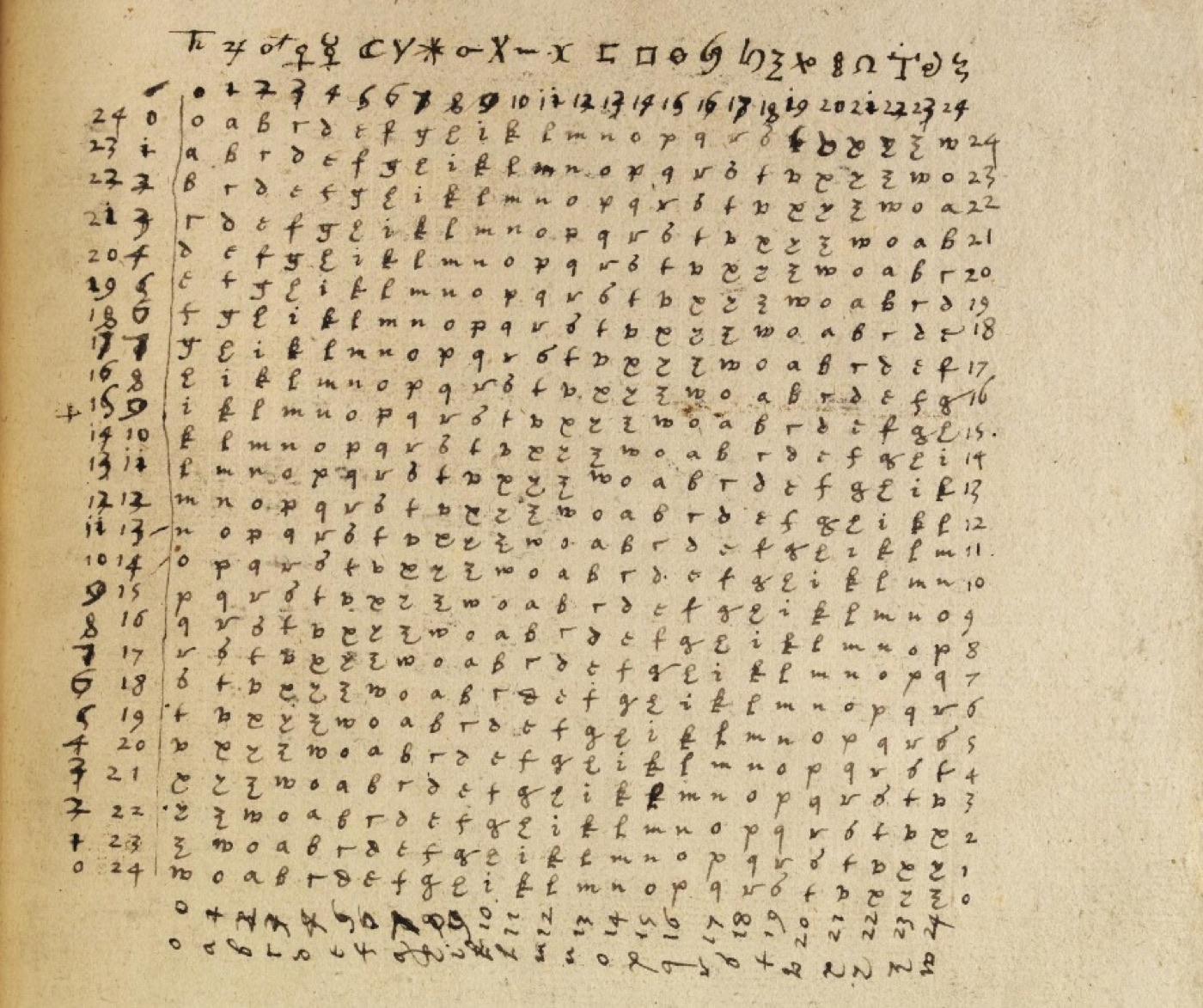
In modern occultism, Dee's influence endures most vividly through the Enochian system, birthed in his angelic conversations with Edward Kelley. Preserved in manuscripts like Sloane MS 3191, the angelical language became a cornerstone of Western esotericism. Material relics amplify Dee's cultural fascination. His obsidian showstone, possibly Aztec, resides in the British Museum alongside the Sigillum Dei Aemeth, conjuring table, and scrying crystal — objects embodying his magical practice. The Voynich Manuscript, a cryptic codex he reportedly sold to Rudolf II for 600 ducats in 1586, tantalizes cryptographers and historians, its undeciphered glyphs a mirror to Dee's own esoteric opacity. His library, once England's greatest, was looted after his 1583 departure, but surviving tomes, bearing his marginalia in the Bodleian and British Library, reveal his omnivorous intellect. Exhibitions, like the Royal College of Physicians' 2016 display, juxtapose these artifacts with his diaries, drawing a wider audience to contemplate Dee's work.
Dee's philosophical core, crystallized in works like the Monas Hieroglyphica, anchors his legacy's depth. "This Monas… containeth the whole Philosophy." Too abstract for gold-hungry patrons, it captivated cryptographers and mystics, its elegance a testament to Dee's belief that numbers bridged the divine and mundane. His angelic dialogues, yielding Enochian, extended this perspective, seeking revelation through the language spoken in Eden.
The dramatic arc of Dee's life — from Elizabeth's favored philosopher, visited on horseback at Mortlake, to James I's outcast, shunned for "superstition or magic" — mirrors the Renaissance magus's precarious dance with power. His favor under Elizabeth shielded pursuits that risked heresy; James's disdain stripped that aegis, leaving him to die in 1608, a shadow of his former self. This rise and fall reflects not just personal fortune but the era's shifting tolerance for intellectual liminality, where Dee thrived until the boundaries he straddled began to harden. Dee's enduring significance lies in his refusal to conform to disciplinary silos, a stance that challenges simplified narratives of scientific progress. His Monas and Enochian system, born of telescope and scrying stone, reveal a mind where mathematics illuminated alchemy, and angelic whispers informed navigation — a holistic outlook at odds with modernity's compartments. His Mortlake library and his diaries, raw with faith and doubt, offer a portal to an age when knowledge knew no bounds.
Straddling Elizabethan England's permeable frontiers, Dee mirrors a world where science and spirit were not foes but kin. His life invites us to rethink the roots of our modern disciplines — tangled, vibrant, and defiantly plural. From Prospero's staff to Crowley's Calls, from imperial charters to the Voynich's riddles, his echoes linger, a polymathic whisper across time. What might the angels still murmur to a world poised, like his own, at its own crossroads of knowing?
References