Essay
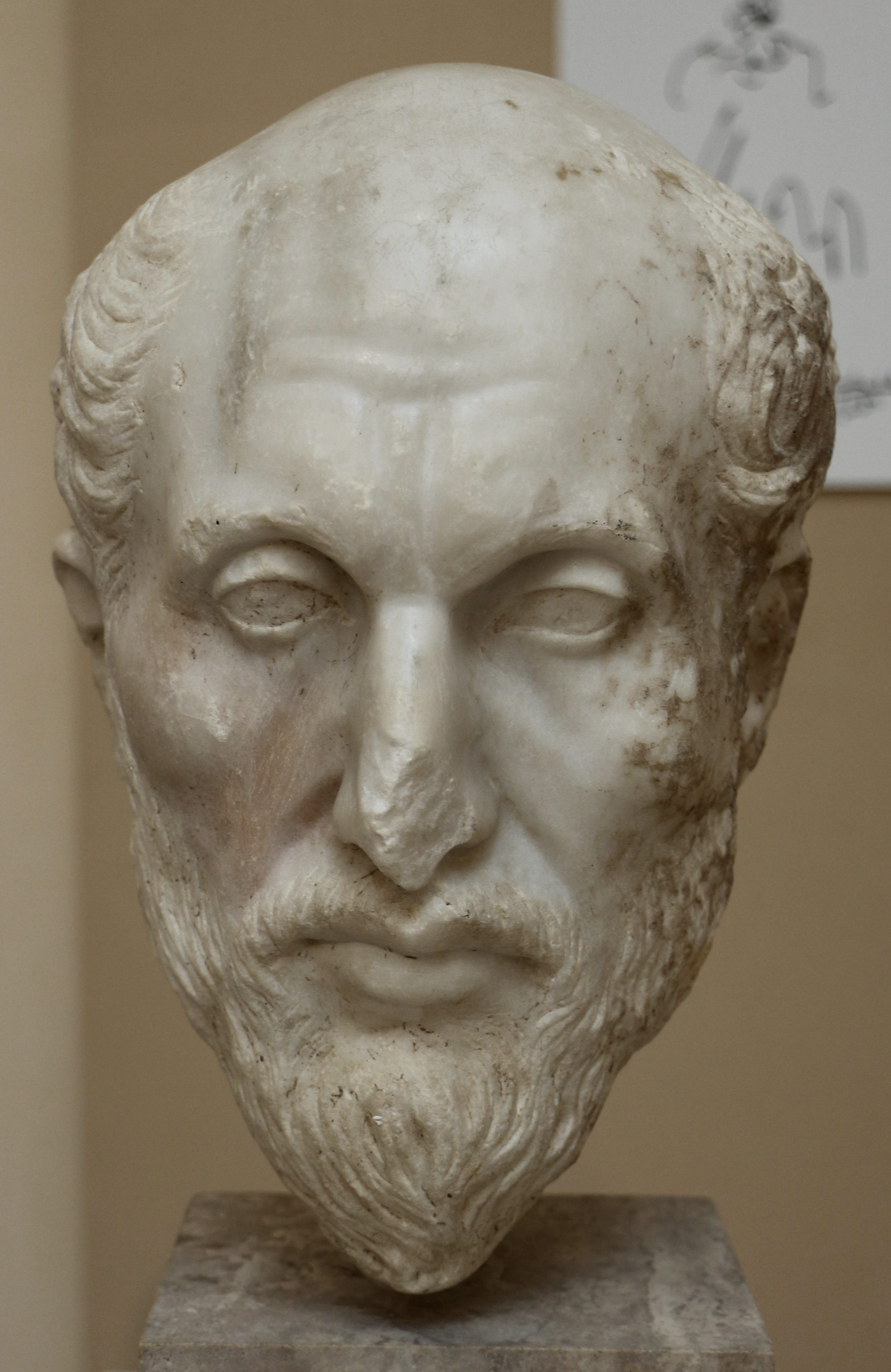
Marble head traditionally identified as Plotinus, 3rd century CE, Museo Ostiense, Ostia Antica. Photo: Sailko / Wikimedia Commons (CC BY 3.0).
Plotinus (c. 204–270 CE) was a Greek philosopher born in Egypt and educated in Alexandria, a rich melting pot of cultures and traditions. Alexandria had long been established as one of the ancient world's most vibrant intellectual and cultural hubs, a crossroads where Greek, Egyptian, Roman, Jewish, and Eastern influences mingled dynamically. Plotinus is largely recognized as the architect of Neoplatonism, the syncretic philosophical movement that emerged from a reinterpretation of Plato's ideas infused with Gnosticism. Plotinus' Enneads, compiled by his student Porphyry, weave together Platonic idealism, Aristotelian metaphysics, and mystical ideas drawn from Hellenistic and possibly Mediterranean and South Asian philosophies. Spanning 54 treatises, the Enneads cover a wide range of topics, including metaphysics, psychology, ethics, and aesthetics.
At the core of Plotinus' thought is contemplation (theōria), a concept that transcends the notion of passive reflection, emerging instead as a creative and active unifying vision that animates all existence. For Plotinus, contemplation is not merely a human faculty but a cosmic principle, operative from the humblest natural processes to the ineffable unity of the One, the ultimate source of reality. True knowledge is not discursive reasoning but direct intuition; an immediate, unifying awareness of truth. This knowledge is not about external objects but about becoming one with the object of contemplation itself. Contemplation is a fundamental principle of the universe in which all of nature, in its own way, engages in the act. Plotinus sees contemplation as the very essence of being. To exist is to contemplate. Even plants and inanimate objects participate in contemplation by expressing their inherent nature and striving towards their ideal form. As Plotinus suggested, "All things contemplate."
Plotinus described a triadic structure of reality, a hierarchy of three hypostases:
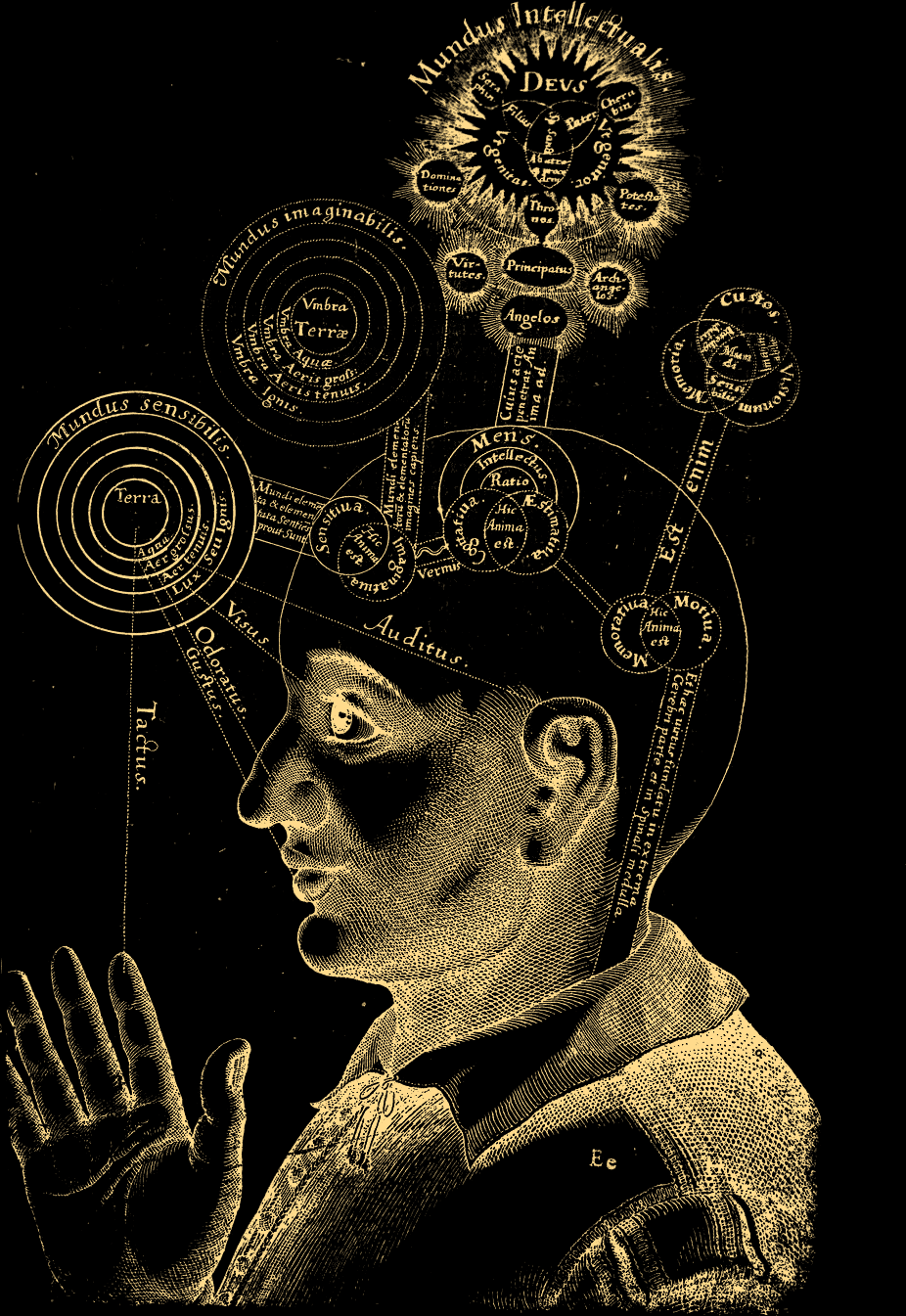
The cosmos is a dynamic process of emanation, where each level derives from the one above it while striving to return to its source. The act of contemplation is how this return occurs.
The One is utterly simple, beyond being, thought, or multiplicity, an infinite source radiating reality without diminishment. Intellect emerges as the One's first emanation, a realm of unity-in-diversity where the eternal Forms reside, contemplating both the One and itself. Soul flows from Intellect, straddling the intelligible and sensible worlds, animating the cosmos and individual beings.
Contemplation is the connecting process that drives this cascade. Plotinus writes, "The One, perfect because it seeks nothing, has nothing, and needs nothing, overflows and its superabundance makes something other than itself." Intellect contemplates the One, not discursively but through an immediate, timeless vision, generating the multiplicity of Forms as it "thinks" them into being. Soul, less unified, contemplates Intellect, projecting these Forms into time and matter, creating the sensible world. This is not a mechanical process but a creative and living one: contemplation is the act of seeing that simultaneously produces, akin to Aristotle's energeia (actuality) but infused with a Platonic ascent toward unity. The entire process is dynamic and creative.
Unlike Plato, who sharply divides the sensible and intelligible, Plotinus sees contemplation as a continuum. Even matter, the shadow at the edge of emanation, reflects the One's potency indirectly through Soul's vision. Reality is a tapestry woven by contemplative acts, from the highest unity to the lowest multiplicity.
Importantly, Plotinus introduces the concept of "creative contemplation," suggesting that perfect contemplation is an inherently individual, creative and productive force. This idea bridges the gap between thought and action, between the ideal and the material. For Plotinus, the universe itself is the result of the contemplative activity of the hypostases. Through creative contemplation, the soul can ascend back through the steps of emanation and ultimately achieve union with the One.
Plotinus says that "…all things are striving after contemplation, looking to Vision as their one end…" (Ennead III.8). Theōria is not a detached intellectual exercise but an intuitive, holistic grasp of reality, distinct from discursive reasoning (dianoia), which dissects and compares. "Reasoning is in the soul… but contemplation is above soul, in Intellect, and beyond Intellect in the Good." (Ennead VI.7).
Contemplation is a seeing that unites. For Intellect, it is a perfect self-awareness, beholding all Forms simultaneously (Ennead V.3). For Soul, it is a striving to recapture that unity, gazing upward to Intellect while shaping the world below. Plotinus extends this even to Nature, the lowest aspect of Soul, asserting "I contemplate, and the figures of bodies come to be as if they fell from my contemplation." (Ennead VI.7). This is not conscious deliberation but an almost immediate instinctive vision, producing material images of the intelligible.
This universality reflects Plotinus' radical insight: contemplation is the essence of life itself. He argues that action (praxis), often seen as primary, is a "weakness" of contemplation, a fallback when vision falters. This is similar to Plato's process of looking to the Forms, yet with a deeper connotation: contemplation is not just knowing, but is being itself.
In Ennead III.8.1, Plotinus imagines Nature speaking: "What you see in me is my contemplation… silent, because I am a shadow of the intelligible." Nature, as the productive power of the World Soul, does not plan or reason; rather, it contemplates Intellect in a dreamlike state, and from this vision, plants, animals, and the cosmos emerge. A tree grows not by calculation but by an innate striving toward the Good, its form an echo of the Forms.
Plotinus likens the World Soul's contemplation to an artist's inspiration: "It makes without moving, by its looking." The stars, rivers, and mountains are thus contemplative products, their beauty a trace of intelligible harmony. The material world, matter itself, participates indirectly, shaped by Soul's vision into ordered multiplicity. This challenges our modern mechanistic view of nature, and resonates with modern theories in quantum physics. The observer effect is the theory that the act of measurement affects the outcome of a quantum system. This suggests that the mere act of observation influences reality, and that consciousness itself plays a role in determining our physical reality.
For the human soul, contemplation is both a return and a revelation. In Ennead I.6.7, Plotinus writes, "Withdraw into yourself and look… like a sculptor, cut away all that is excessive, straighten all that is crooked, bring light to all that is shadowed." The soul, a fragment of the World Soul, has "fallen" into the body, distracted by sensation (Ennead IV.8). Yet its essence remains divine, capable of ascending through contemplation.
This ascent is a three-stage purification. First, the soul turns from bodily desires, practicing virtue to quiet its lower parts (Ennead I.2). Next, it contemplates the Forms via Intellect, engaging in philosophical reflection to grasp eternal truths (Ennead V.3). Finally, it seeks the One, transcending Intellect in a rare, ecstatic union (Ennead VI.9) that is an immediate illumination where subject and object are dissolved, and the vision is filled with light:
"And this is the soul's true end, to touch that light and contemplate it by itself, not by another light, but by the very light which is its means of vision; for that by which it sees is that which it must see. And so it must come to be like it, and when it has become like it, then it is fitted to see it: for this is the soul's vision, when it has become a unity and has put away all multiplicity. And one who has seen it, when he has seen it, does not see it as distinct, but as himself, and he is it, not in substance but in act, and he is not himself separated from it, but he becomes it. For there is no longer a duality, but as it were a contact of the soul with it, and a union and a vision beyond all vision: for it sees by a kind of self-blinding, since it does not see it as an object of sight, but as that with which it becomes identical."
Plotinus, Enneads VI.9
This is deeply resonant with samādhi, a Sanskrit term meaning "absorption" or "union." Samādhi is a state of profound meditative concentration where the mind becomes fully unified with its object, transcending ordinary perception and duality. Rooted in Patañjali's Yoga Sutras (2nd century CE), this is a formless, selfless immersion in pure consciousness or the divine. The Visuddhimagga of Buddhism describes samādhi as a still, luminous awareness free of distraction, where subject and object dissolve.
Comparing this to Plotinus, both depict a contemplative ecstasy where the self merges with the ultimate. The soul's "self-blinding" is its surrender of Intellect's multiplicity, ceasing to see the One as a separate "object" and becoming one with it "not in substance but in act." This echoes nirvikalpa samādhi's dissolution of duality, where the yogi's awareness fuses with the absolute, beyond thought or form. Both require a letting-go: Plotinus' soul blinds itself to distinctions, akin to samādhi's stilling of mental fluctuations. While Plotinus' ecstatic union is rare and grace-like, samādhi is a disciplined attainment; both shimmer with the same non-dual glow.
This is not abstract theory but a lived practice. In Ennead I.4, "On Well-Being," Plotinus ties contemplation to happiness (eudaimonia): "The good life is the life of Intellect… not needing external things." Plotinus identifies contemplation with the highest form of happiness. The soul, when immersed in material concerns, is fragmented and restless. Through contemplation, it recollects its divine origin and experiences true fulfillment. This echoes Plato's concept of the philosopher's ascent in the Allegory of the Cave, where the soul turns away from the illusory shadows toward the light of reality.
A pivotal aspect of Plotinus' vision of the Soul's contemplation lies in the profoundly individual nature of this process, where each soul engages with reality through its own lens of perception. In Ennead III.8.4, he explains that the Soul, as it contemplates the Forms emanating from Intellect, interprets these eternal truths according to its unique cognitive capacities and inherent limitations — its "productive power" shaped by its distinct essence. Nature, for instance, contemplates dimly, producing material forms "as if they fell from its vision," while human souls, with greater clarity, still filter the intelligible through their own intellectual and experiential makeup. This means that each soul doesn't merely reflect a universal truth but actively constructs its experience of reality, aligning it with its particular character — a process Plotinus sees as both creative and inevitable (Ennead III.8.4: "Each thing produces according to its own nature"). This concept anticipates modern cognitive science, which reveals how personal beliefs, intelligence, and lived experiences give rise to cognitive biases — systematic patterns of thought like confirmation bias or the framing effect, where we favor evidence supporting our preconceptions or interpret data based on how it is presented. In essence, Plotinus' insight prefigures the adage "seeing is believing": our mental framework does not just passively receive reality but fundamentally shapes it, much as the Soul's contemplation weaves the Forms into a tapestry tinted by its own hue. This individuality underscores Plotinus' view of contemplation as a dynamic, creative, living act.
The One stands as the apex of Plotinus' metaphysics, embodying a paradox that both defies and defines the soul's contemplative journey as "beyond being" (Ennead VI.9.3). Eluding the grasp of conventional thought or perception, the One remains the ultimate goal toward which all existence strives. This supreme principle, to Hen (τὸ Ἕν), is not a being among beings but the transcendent source of all — simple, indivisible, and overflowing with a "superabundance" that generates Intellect and Soul without diminishing itself (Ennead V.2: "It is perfect because it seeks nothing, has nothing, and needs nothing"). In Ennead VI.9, Plotinus insists, "It is not to be seen as an object… but as that with which we become identical," suggesting a union so profound that the soul doesn't merely behold the One, it becomes it, and in the process sheds Intellect's stable, structured vision of the Forms for a suprarational embrace. He likens this to "a light seen by a light" (Ennead VI.7), an image of luminous fusion where the soul's innermost "center" (Ennead VI.9) touches the One's boundless simplicity, transcending all multiplicity in a moment of pure presence. This resonates with modern notions like "unity consciousness" or "cosmic consciousness," terms from mystical and psychological traditions (e.g., Bucke's Cosmic Consciousness) that describe a state of awareness where the self dissolves into an all-encompassing oneness, free of duality or limitation. For Plotinus, the One is not just a personal goal but the cosmic ground, akin to the universal mind or infinite awareness. However, the One remains uniquely ineffable, a paradox of absence and plenitude that contemplation alone can approach.
It is also worth looking, even if briefly, at the Eastern contemplative philosophies which may have helped to influence the development of Plotinus' contemplation. His notion of the One resonates with the Eastern philosophical ideas of the Void, particularly Śūnyatā from the Buddhist tradition. This is a rich intersection, as both Plotinus' Neoplatonism and Eastern thought grapple with the nature of ultimate reality, the limits of language, and the role of direct experience over conceptual reasoning.
For Plotinus, contemplation (theōria) is the soul's intuitive vision, a unifying act that ascends from the sensible world through Intellect (Nous) to the One. The One is the source of all reality — complete, beyond being, thought, or multiplicity. In Ennead VI.9, he writes, "It is not to be thought as one among many… it is before all things," and in VI.9, he describes contemplation as the soul "becomes one" with it, not through concepts but through ecstatic union. This is not a passive void but an overflowing plenitude, a "superabundance" (Ennead V.1) that generates existence without intention. Contemplation here is both the process of ascent and the fleeting experience of unity, beyond the grasp of intellect alone.
In Eastern philosophy, Śūnyatā — a Sanskrit term meaning "emptiness" or "voidness" — is central to Mahayana Buddhism, especially in the Madhyamaka school founded by Nagarjuna (c. 150–250 CE, roughly contemporary with Plotinus). This is not a nihilistic nothingness but a profound insight: all phenomena lack inherent, independent existence (svabhava). In the Mūlamadhyamakakārikā, Nagarjuna states, "Dependent co-arising — this we call emptiness," meaning that things exist interdependently, not as self-contained entities. Śūnyatā is thus the ultimate reality behind appearances, realized through meditative insight (prajñā), which transcends dualities like being/non-being or self/other. In Zen and other traditions, this realization often culminates in a direct, non-conceptual experience of the Void, akin to a boundless openness.
Both the One and Śūnyatā defy description. Plotinus insists the One is "beyond being," echoing Plato's Good but pushing further into ineffability. Language fails it; we approach it by negation, stripping away attributes (Ennead V.3: "We say what it is not, not what it is"). Similarly, Śūnyatā eludes positive definition, as Nagarjuna's method dismantles all conceptual frameworks. For both, ultimate reality is not grasped by reasoning but through a direct, intuitive act, the act of contemplation or meditative insight.
Plotinus' One is the source of multiplicity yet remains undivided, a unity that Intellect and Soul strive to recover through contemplation (Ennead VI.9: "The soul… becomes one, not in substance but in act"). Śūnyatā also dissolves dualities — self/other, existence/non-existence — revealing an interdependent unity beneath appearances. In the Heart Sutra, "Form is emptiness, emptiness is form" captures this collapse of opposites, mirroring how Plotinus' One underlies all forms without being any one of them. Contemplation in both systems moves toward this non-dual state, whether as ecstatic union or enlightened awareness.
A parallel lies in how both concepts invert our usual sense of absence. The One's "emptiness" of attributes, lacking all form, thought, or limitation, makes it infinitely generative (Ennead V.2: "It overflows"). Likewise, Śūnyatā's emptiness of inherent existence is not barren but the condition for all phenomena to arise interdependently, a dynamic potentiality. Plotinus calls the One "the productive power of all things," akin to how Mahayana sees Śūnyatā as the womb of reality, pregnant with possibility, a "radical non-dualism":
"Esoteric Buddhism accepts that the dharmas are transitory and fleeting, but totally rejects the view that they are in any way unreal. Even though the things of the sensible world are ephemeral and every-changing, they are real, just as they are. The physical world and its Voidness are two aspects of a single Reality; there is no Void without phenomenal forms and no phenomenal forms without their Voidness. Forms and the Void are indissolubly merged, and they are both equally real. Unenlightened men, however, see only one aspect of this Reality, whereas the Awakened Buddhas see both aspects in their instantaneous union."
The Matrix and Diamond World Mandalas of Shingon Buddhism
Plotinus' philosophy, particularly in Ennead VI.9 ("On the Good or the One"), aligns closely with the Esoteric Buddhist view that the Void and phenomenal forms are two inseparable aspects of Reality. In Shingon Buddhism, the dharmas, though fleeting, are not unreal; rather, the Void and the world of forms are fundamentally one. Similarly, Plotinus teaches that the One, though beyond all being, is the source of all things, and that the world, while less real than its source, still participates in Reality. He states, "The One is all things and not a single one of them… It is because there is nothing in it that all things come from it." This echoes the Buddhist notion that Voidness is not mere negation but the very foundation of existence. Just as the Awakened in Buddhism perceive both aspects of Reality in their union, Plotinus holds that the philosopher can transcend illusion and intuit the One directly, recognizing the unity behind apparent dualities.
Similarly, the Diamond Sutra states: "Dwelling nowhere, mind comes forth." In this sutra, the Buddha urges the cultivation of the mind of enlightenment that "alights upon nothing whatsoever," a state of non-abiding (apratiṣṭhita) where wisdom arises free from attachment to forms, concepts, or even the self. This mirrors Plotinus' One as "beyond being," a transcendent simplicity that exists nowhere in the realm of multiplicity or definition. For Plotinus, the One does not dwell in any specific place or thought, rather it is the placeless source from which Intellect and Soul emanate, much as the sutra's enlightened mind emerges unbound, a spontaneous clarity born from emptiness. Both point to a reality that defies fixation, inviting a contemplative leap beyond the grasp of ordinary perception.
This resonance deepens when we consider contemplation's role in accessing these truths. Plotinus' theōria is the soul's ascent, culminating in a "self-blinding" union with the One, where all forms dissolve into an ineffable act of being. Similarly, the Diamond Sutra's non-abiding mind arises through meditative insight (prajñā), shedding illusions of inherent existence to rest in a boundless awareness. The sutra's negation of phenomena as "a dream, an illusion" parallels Plotinus' view of the sensible world as a shadow of Intellect, with contemplation lifting the veil in both.
It is interesting to note the Tibetan tradition of Dzogchen, meaning "Great Perfection," teaches that the base of reality is an innate, pristine awareness called rigpa, which is the natural state of mind: pure, luminous, and empty of inherent existence. In Dzogchen enlightenment is not achieved but recognized. Rigpa is already present, obscured by ignorance. The Kunjed Gyalpo (a foundational tantra from the 9th century CE) describe rigpa as "self-arisen primordial wisdom," beyond dualities of subject/object or existence/non-existence. It is not a "thing" but a spacious clarity, often likened to the sky, as empty yet radiant, or a mirror that reflects everything but is itself unchanged and devoid of descriptive qualities.
Practitioners access rigpa through direct introduction by a master and sustained contemplation, resting in this naked awareness without grasping. Longchenpa (14th century) calls rigpa "the pristine awareness that is the ground of being," empty yet luminous, akin to the One's ineffable potency. Both elude definition, existing as a foundational reality prior to all distinctions. Dzogchen practice involves "pointing-out instructions" to recognize rigpa directly, bypassing gradual meditation or elaborate rituals. Rigpa is non-dual awareness, neither self nor other, neither existent nor non-existent. The practitioner rests in "open presence" (lhundrub), a luminous immediacy that echoes Plotinus' ecstatic merger. Like Plotinus, the realization is not about building something new but uncovering what is already present. This is an instantaneous shift from distraction to awareness. The meditative practice of trekchö ("cutting through") mirrors in many ways Plotinus' "self-blinding," a letting-go into clarity.
The contemplative approaches of Plotinus' Neoplatonism, Mahayana Buddhism, and Dzogchen share deep similarities in their pursuit of ultimate reality, non-duality, and transcendence. While these traditions emerged in distinct cultural soils — Plotinus in 3rd-century Alexandria, Nagarjuna's emptiness in 2nd-century India, and Dzogchen in 8th-century Tibet — their echoes trace back to subtle threads of intellectual exchange, with Alexandria serving as a vibrant hub. This Hellenistic metropolis, where Plotinus studied under Ammonius Saccas, was thriving with cross-cultural currents, linked to India through Silk Road caravans and Red Sea ports. As early as the 3rd century BCE, Emperor Ashoka's Buddhist emissaries reached Hellenistic regions, fostering Greco-Buddhist dialogues that flourished in the Indo-Greek kingdoms of Bactria. By the 1st century CE, the Prajñāpāramitā texts were circulating in India, their ideas potentially drifting westward via trade and philosophical discourse to mingle in Alexandria's melting pot. There, Plotinus forged his vision of the One, a unity beyond being that resonates with emptiness (śūnyatā). Centuries later, Dzogchen's rigpa — a pristine awareness mirroring the One's simplicity — emerged in Tibet, perhaps catching faint ripples of Neoplatonic thought carried eastward over time. The interplay of these philosophical rivers reflects a shared contemplative current, flowing through diverse cultures to touch the same boundless source.
Plotinus did not write meditations, he taught philosophy as a lived practice, expecting contemplation to emerge through discourse and introspection. However, we can get a taste of what Plotinus was getting at by using his writings as a framework for a contemporary meditation.
Find a quiet space where you won't be interrupted. Sit comfortably with your back straight but relaxed, mirroring the soul's upright striving toward Intellect. Dim the lights or light a candle if it helps create a calm atmosphere.
This meditation unfolds in three phases, reflecting Plotinus' stages of ascent: purification (detaching from the sensible), contemplation of the intelligible (engaging the mind's higher vision), and unity (approaching the One):
Purification
Close your eyes and take a few deep breaths, letting your body settle.
Bring your attention to the sensations around you — sounds, the feel of the air, the weight of your body. Acknowledge them without judgment, as Plotinus might see these as the soul's entanglement in matter (Ennead IV.8.1).
Now, gently release them. Imagine each sensation as a layer falling away, like "cutting away all that is excessive" (Ennead I.6.7). Say silently to yourself, "This is not me," with each distraction — whether a noise, a thought about work, or a physical itch.
Rest your focus on your breath, a steady rhythm that anchors you beyond the many sensations of the body. Feel your awareness turning inward, as if stepping back from a busy stage into a quiet room.
Contemplating the Intelligible
Shift your attention to a simple, universal idea. Plotinus might call this a shadow of the Forms. For example it could be Beauty, Truth, or Goodness. For this meditation we will use Light as an example, since Plotinus often equates Intellect with illumination (Ennead V.3.8).
See a soft, steady light in your mind — not a physical object, but a presence that grows as you focus on it. Don't force it; let it emerge naturally, as Intellect contemplates effortlessly.
Ask yourself, silently: "What is this light?" Don't answer with words — feel its qualities. Is it calm? Vast? Timeless? This isn't reasoning (dianoia), but a direct seeing (theōria), like gazing at a star without naming it.
When thoughts wander, gently return to the light. Plotinus would say these are the soul's lower parts tugging at you; let them fade by resting in the vision. Over time, the light might feel less like an image and more like a state you are entering.
Unity
Now, let the light dissolve. Plotinus describes the One as beyond form or concept (Ennead VI.9.3), so release the image entirely. Shift to pure awareness, just the sense of being present. Be aware of awareness itself.
Rest in this stillness. If your mind seeks something to hold onto, let go again, trusting the emptiness. Plotinus might call this "self-blinding" (Ennead VI.9.11) — not seeing anything specific, but becoming one with what's beyond.
You might feel a fleeting sense of expansion or peace, like "a light seen by a light" (Ennead VI.7.36). Do not try to chase it or be attached, just be with it.
When ready, let your awareness gently return to your breath, then your body, carrying that stillness with you. Open your eyes slowly. Take a moment to notice the room and your environment. Does it feel different? Plotinus believed contemplation reshapes how we see the world, revealing traces of the intelligible even in the sensible (Ennead III.8.11).
Plotinus' concept of contemplation unfolds as a rich, multifaceted lens, illuminating the intricate interplay of reality, consciousness, and the human experience with a brilliance that transcends his 3rd-century world. By casting contemplation as a universal principle that is not merely a human act but the very pulse of existence, from Nature's dim vision to Intellect's eternal gaze, he crafts a framework that seamlessly unites metaphysics, epistemology, ethics, and aesthetics into a single, harmonious vision. The One, the radiant source beyond being, anchors this cosmos, its overflowing simplicity generating all multiplicity while remaining ever elusive, a paradox that invites the soul to shed its earthly veils. Plotinus reminds us that the Soul interprets impressions and Forms through its own intellect, each perception a singular dance of light refracted through its unique prism. The One, like a master weaver of a cosmic "coat of many colors," drapes its singular essence across the vast loom of time, cultures, and individuals — each thread a distinct hue, from the vibrant bustle of Alexandria's Hellenistic crossroads to the boundless void of Eastern thought. In the melting pot of Alexandria, where Greek reason met Egyptian mystery and whispers of India's wisdom drifted via Silk Road winds, Plotinus wove his tapestry, its patterns echoing across centuries to touch the contemplative hearts of Mahayana sages and Dzogchen masters. Yet all these threads are woven from the same Source, the One's infinite unity threading through the fabric of existence. Ultimately, Plotinus beckons us to reimagine ourselves and the world as vital strands in this grand contemplative tapestry, ever striving toward unity and perfection, where the soul's silent gaze merges with the eternal light of the One.
References